
ADOC Releases for Covington Sentences
The Alabama Department of Corrections is not a Covington County facility, and the research did not identify a major ADOC prison located in Covington County. It is still a required release path because a Covington County felony case can end with a sentence to state prison. When the person leaves the county jail for ADOC, the county event is a transfer. The final prison release or discharge happens later under ADOC, ABPP, court, and sentence-credit rules.
From ADOC, a person may release to parole, mandatory release supervision, probation, work-release or community status, end-of-sentence discharge, another jurisdiction, medical release, or death. Each outcome has a different record trail. A parole grant is not the same as a physical release date, and a county jail transfer is not the same as community release.
| ADOC outcome | Where to check | Covington County connection |
|---|---|---|
| Current state custody | ADOC inmate search | Covington sentence may have transferred from county jail. |
| Minimum release date | ADOC fields and definitions | Jail credit can come from the Covington County Circuit Clerk. |
| Parole or mandatory release | ABPP and Alabama VNS | Supervision may route through the Andalusia Field Office. |
| Discharge after release | ADOC records request, court, ABPP | ADOC public search may no longer return the person. |
ADOC Search for Released Inmates
The ADOC inmate search accepts AIS number, first name, and last name. The AIS number is the strongest field when known because it is the unique ADOC identifier. Name searches can return many records, and ADOC displays limits on broad results. The search is for current ADOC custody, so it should not be described as a complete historical released-inmate archive.
- Confirm from the court or jail that the person was sentenced or transferred to ADOC.
- Search by AIS number if available, or by first and last name.
- Open the matching record and read facility, sentence, Minimum Release Date, Parole Consideration Date, and Parole Status fields.
- Use the ADOC definitions to interpret release-related fields.
- If no record appears after suspected discharge, use ABPP, VNS, court, registry, or ADOC public-records channels.
ADOC's public search page is a useful source for Covington County state-prison checks because it documents the current-custody limit.
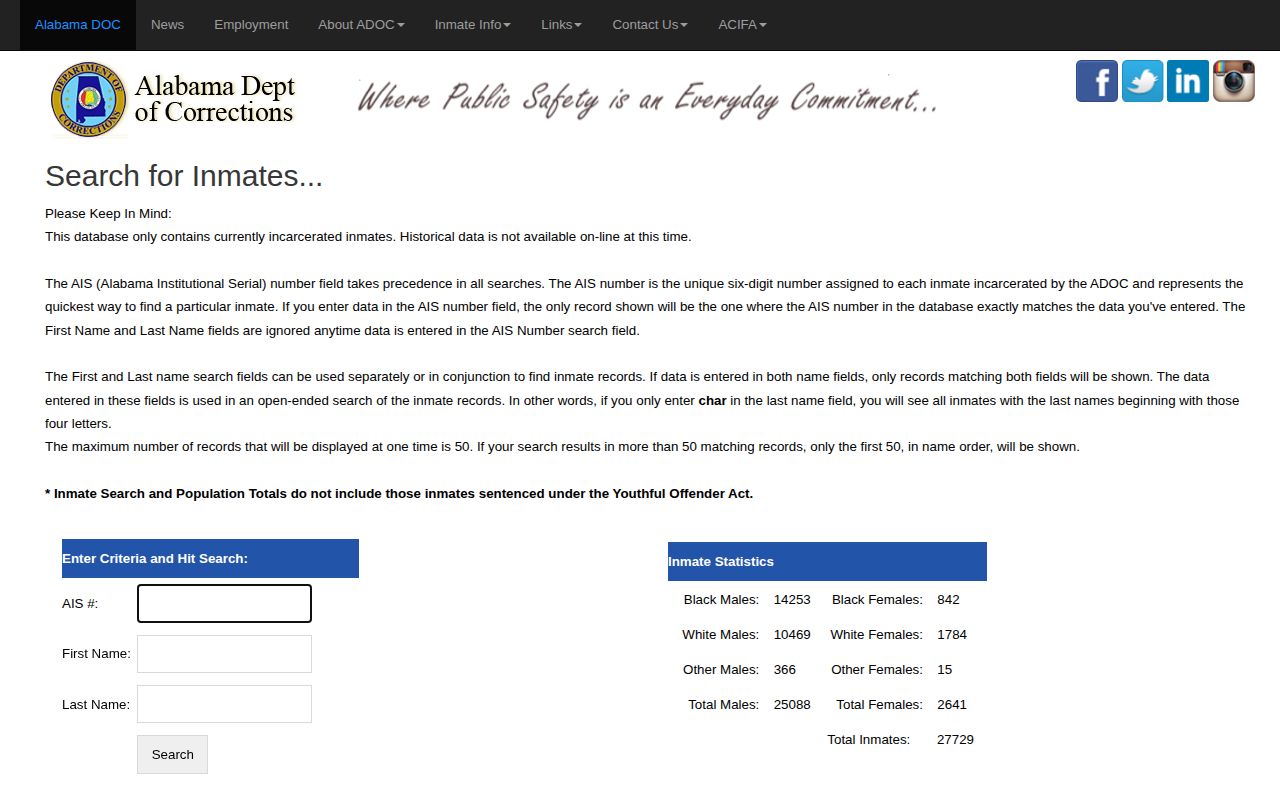
The page helps confirm a current state prisoner, but the lack of a result after discharge should be reconciled with other official records.
ADOC Minimum Release Date
ADOC's wording matters. The public field is "Minimum Release Date," and ADOC defines it as the earliest scheduled date an inmate can be released to probation or end of sentence. ADOC also says that date can change if the inmate receives disciplinaries that take away good time or if the circuit clerk sends new cases or changes the sentence. For a Covington County sentence, the local circuit clerk may be the source of jail credit sent to ADOC.
Other ADOC fields also affect how the date should be read. Jail Credit is time spent in county jail before sentencing. Good Time Received and Good Time Revoked show sentence-credit movement. Parole Consideration Date is tentative, not a promised release date. Parole Status can point to supervision, delinquency, or revocation status, but ABPP is the supervision agency to verify the status details.
ADOC Release Records Contact
When the release or discharge record belongs to state prison custody, use ADOC's records route rather than the county jail. ADOC's site navigation exposes a Request Public Record path. A request can ask for state-prison release or discharge dates, sentence calculation records available for public release, location history, and photo records when permitted.
301 South Ripley Street
P.O. Box 301501
Montgomery, AL 36130-1501
Phone: 1-855-WE-R-ADOC (937-2362)
Search: doc.alabama.gov/inmatesearch.aspx
For court-certified proof of the original sentence, jail credit, or probation order, use the Covington County Circuit Clerk. For supervision after release, use ABPP. For notification records, use Alabama VNS if the person is a covered ADOC-sentenced offender.
Covington County ADOC Supervision
Leaving ADOC custody does not always mean the person is free of supervision. Alabama mandatory release, parole, probation, and post-release supervision can follow incarceration. ABPP lists a local Andalusia Field Office serving Covington County, which makes it the practical local point for supervision routing. The office can be relevant after a parole grant, mandatory release, delinquency, absconder alert, or revocation question.
ABPP hearing results and scheduled hearing pages can show grants, denials, continued matters, and reset dates. A reset date is the first month and year for possible future docket placement, not the date of a new hearing. A parole grant requires home-plan verification and coordination with ADOC before physical release, so the release date should be confirmed through the correct record path.
- Parole
- Conditional release from prison under ABPP supervision.
- Mandatory release
- Release to supervision under Alabama law before end of sentence for eligible inmates.
- Discharge
- The end of incarceration or sentence custody, depending on context.
Covington Jail Credit in ADOC
Jail credit is one of the places where Covington County records can affect an ADOC release date. ADOC defines Jail Credit as time spent in county jail before sentencing and says the sentencing county circuit clerk prepares that time. For a Covington County sentence, questions about missing or corrected jail credit route back to the Covington County Circuit Clerk before ADOC can reflect the change.
Correctional incentive time is a separate state-prison credit issue. Alabama Code Section 14-9-41 sets earning classes and exclusions, while discipline can revoke or stop credit. A reader should not try to compute an ADOC release date from the county jail booking alone. The court judgment, jail credit, ADOC classification, good-time record, holds, parole, and mandatory release rules all interact.
Covington Jail vs ADOC Release
A Covington County Jail release record and an ADOC release record answer different questions. The jail record tells when local custody ended. The ADOC record tells current state custody, scheduled release fields, and state-prison status while the person remains in ADOC. The court record connects both systems because the sentencing order, jail credit, and case disposition explain why the person moved from local custody to state prison or supervision.
Use the county jail page for local booking and release events, and use ADOC for sentenced state-prison custody. When both systems are involved, the timeline should read as a sequence: arrest, booking, court case, county jail release or transfer, ADOC custody, state-prison release or discharge, and any ABPP supervision.
Note: A county jail transfer to ADOC is not the final state-prison release.
ADOC No-Result Checks
A no-result in ADOC should be handled carefully. ADOC says the public inmate search is for currently incarcerated inmates and does not provide historical data online at this time. A former Covington County state prisoner may stop appearing after discharge, but the same no-result can also come from a name mismatch, alias, data limit, youthful-offender restriction, or a case that never reached ADOC.
When ADOC does not return the person, use the court judgment, ABPP supervision records, Alabama VNS if registered and covered, ALEA registry records when applicable, and a public-records request to ADOC. That sequence keeps the state-prison release question tied to official records instead of relying on absence from one search screen.