
Covington County Parole vs Probation
Parole and probation both describe supervision in the community, but they come from different parts of the Alabama system. Parole usually follows a state-prison sentence and a decision by the Alabama Bureau of Pardons and Paroles. Probation usually comes from the sentencing court, either instead of a jail term or after a split sentence. A Covington County release record may show that a person left the Covington County Jail, but the next record to check depends on whether the person was sent to ADOC, released on a local sentence, or placed under court probation.
The difference matters because a jail release does not end all duties in many cases. A person can leave jail on probation, leave ADOC on parole, or move to mandatory release supervision before the sentence expires. The Alabama Bureau of Pardons and Paroles, often shortened to ABPP, is the state agency that supervises parole and many probation cases. The Covington County court record still matters because it can show the judgment, probation order, split sentence, jail credit, revocation hearings, or later discharge.
| Status | Who Creates It | Where to Verify |
|---|---|---|
| Parole | Alabama Board of Pardons and Paroles after state-prison eligibility | ABPP hearing results, ABPP field office, ADOC custody record |
| Probation | Sentencing court, including Covington County district or circuit court | Court case record and ABPP Andalusia Field Office when supervision is active |
| Mandatory release | ADOC date calculation under Alabama law, with ABPP supervision | ADOC, ABPP, and Alabama VNS or VINELink where covered |
| Discharge | Supervising agency or court after the term ends | ABPP, court disposition, or records request |
Verify Covington County Supervision
A supervision check should follow the custody path. If the person was only in the Covington County Jail on a pending local charge, start with the court and jail release record. If the person was transferred to the Alabama Department of Corrections, start with ADOC and ABPP because the county jail release may only mark a transfer to prison. If the person was released from ADOC, parole, mandatory release, or discharge may explain why the person no longer appears in the state prison search.
ABPP records explain parole hearing timing and results, but a hearing result is not the same as a physical release from prison. The agency states that a parole set date means the file can be processed after eligibility. It does not guarantee a hearing in that month. When parole is granted, ABPP must verify the home plan and coordinate with ADOC before release. That is why a person can have a granted result and still remain in custody for a short time.
- Confirm whether the person left Covington County Jail, ADOC, federal custody, or ICE custody. A county jail release and a prison discharge are different events.
- Check the Covington County court record for probation orders, split-sentence terms, jail credit, revocation cases, and disposition language.
- Use ABPP hearing pages for parole eligibility, scheduled hearings, current-year results, and archived hearing-result posts.
- Contact the ABPP Andalusia Field Office when the question is where a Covington County parole or probation case is supervised.
- Use VINELink or Alabama VNS for status-change notice when the person is in a covered ADOC or VINE record.
For a named release-record search that begins with the jail instead of supervision, the broader Covington County released inmate workflow is on Home.
Covington County ABPP Office
Covington County has a named local ABPP office, which makes supervision routing more concrete than a statewide contact alone. The Andalusia Field Office lists Covington County among the counties served. That office is the local supervision contact for many parole and probation questions after a person is released to ABPP oversight.
Alabama Bureau of Pardons and Paroles, Andalusia Field Office
23989 Alabama Hwy 55
Andalusia, AL 36420
Main: 334.923.4266
Fax: 334.427.8604
Monday-Friday, 8:00 A.M. to 5:00 P.M.; closed 12:00 P.M. to 1:00 P.M. and on state and federal holidays
The office detail does not replace the court record. A probation case may begin with the Covington County judgment, and a parole case may begin with an ADOC sentence and ABPP board action. Use the local office to route supervision questions, then reconcile the answer with the sentencing order, release date, and any current violation or discharge record.
The manifest capture for the ABPP Andalusia Field Office shows the local office page used for Covington County supervision routing.
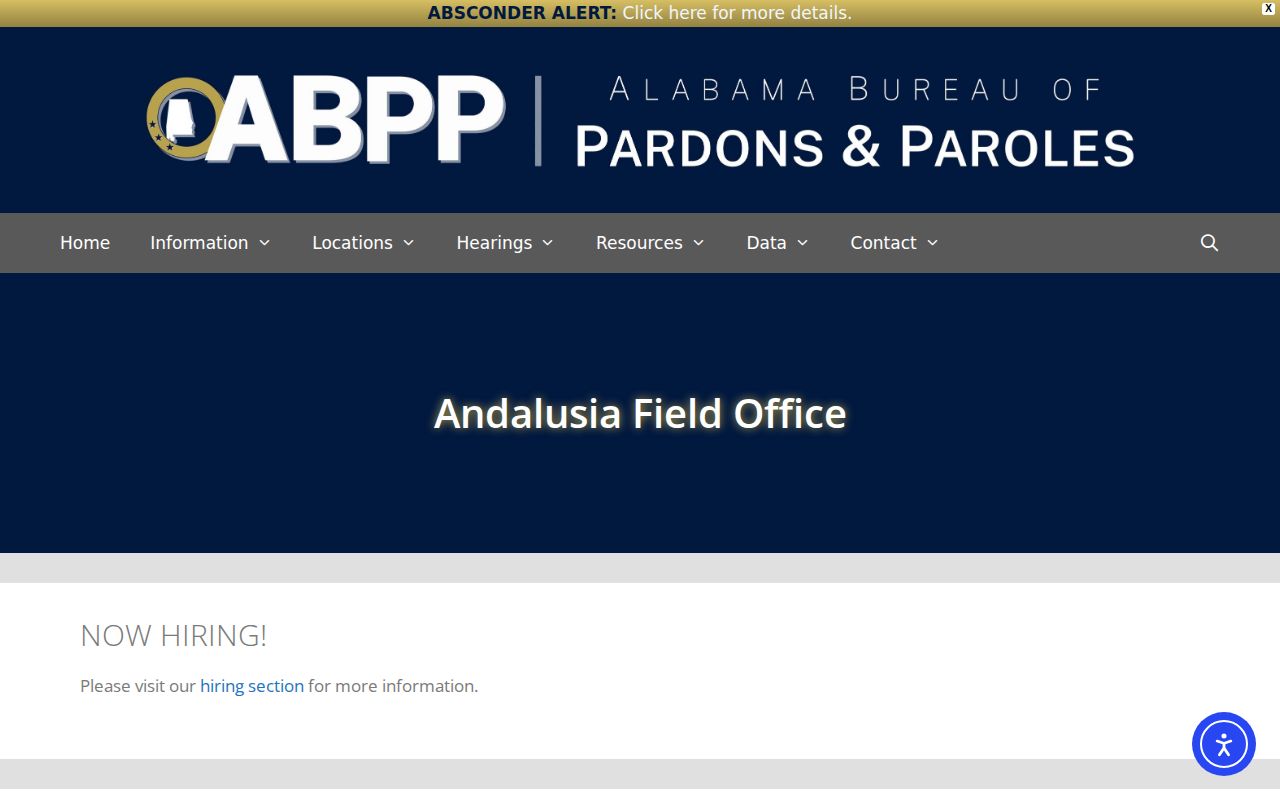
That page is the clearest local ABPP source because it ties the county to a specific field office, phone number, address, and office schedule.
Covington County Parole Hearings
Parole hearing records are useful for a Covington County state-prison case, but they must be read with care. ABPP publishes scheduled parole hearings, current-year parole results, and a hearing-results archive. Those pages can show whether the Board granted, denied, continued, rescinded, or reset a matter. The results page also notes that special conditions are in the minutes for the hearing date.
A reset date should not be read as a new release date. ABPP describes it as the first month and year when the person may be considered for placement on a future docket. If parole is denied with no reset, the person may serve the remainder of the sentence without another parole hearing. If parole is granted, the home-plan verification and ADOC coordination still control the actual prison gate release.
| ABPP Result | Release Meaning |
|---|---|
| Granted | Parole approved, but physical release still waits on home-plan and ADOC coordination. |
| Denied | No parole release from that hearing. |
| Denied with reset | Future consideration may occur, but the reset month is not a hearing date. |
| Continued | The matter was moved to a later Board setting. |
Note: A parole grant is a board action first; the custody release date is confirmed through ADOC and ABPP scheduling.
Covington County Mandatory Release
Mandatory release is a state-prison supervision path, not a county jail feed. ABPP explains that Alabama Code Section 15-22-26.2 applies to eligible offenses committed on or after January 30, 2016. Life sentences and child sex offenses are excluded. ADOC determines the mandatory-release date and coordinates with ABPP, so this status can place a released state prisoner under supervision even though the person has not reached full sentence discharge.
The statutory windows depend on sentence length. For sentences of five years or less, ABPP describes a window of three to five months before end of sentence. For more than five years but less than ten years, it is six to nine months. For ten years or more, it is twelve to twenty-four months. These ranges do not let a reader calculate a private release date. The judgment, jail credit, good-time status, disciplinary history, detainers, and ADOC computation all matter.
- Parole
- Release from prison supervision after a Board grant, with rules set and enforced by ABPP.
- Probation
- Court-ordered community supervision, often tied to a local sentence or split sentence.
- Mandatory release
- Statutory release to supervision before end of sentence for eligible ADOC inmates.
- Absconder
- A supervised person reported as missing from required contact or supervision control.
- Discharge
- The end of supervision or sentence control, confirmed by the responsible agency or court.
Covington County Absconder Status
Absconder and delinquency status are post-release supervision issues. ABPP's public site includes an Absconder Alerts path, and the agency uses parole status terms that can show whether a person is currently on parole, delinquent, or revoked. If a released Covington County person is reported as an absconder, the issue is no longer just whether the person left jail. It is whether the person remains compliant with supervision and whether a warrant or revocation case exists.
Violations may also appear in the court record. Probation revocations, warrant recalls, bond changes, and new charges can move a person back into custody after a prior release. A live jail roster, if one is available through an app or agency channel, only answers whether the person is currently held. It does not explain why supervision changed. Use the ABPP field office, the court docket, and the jail record together when a released person appears to have been re-arrested or reported delinquent.
Covington County Reentry Supervision
The local reentry landscape found in the research is ABPP-centered. No separate Covington County reentry office was identified in the source sweep. ABPP lists field operations, day reporting centers, day reporting center lites, and the Andalusia Field Office that serves Covington County. That means state-prison release questions about reporting, compliance, and supervision routing point to ABPP, while ADOC remains the source for prison placement and release-date computation.
This distinction helps keep the record trail clean. ADOC can show a current inmate's custody fields before release, including parole status fields and the minimum release date. ABPP handles parole hearings, probation and parole supervision, absconder alerts, mandatory release supervision, and discharge questions within its public-information limits. The Covington County court record anchors probation terms and case outcomes. A reliable post-release answer uses the agency that controls the next step, not just the agency that last held the person in a cell.
Public Record Search
Sponsored Results