
Covington County Minimum Release Date
For Alabama state-prison records, the public term is "Minimum Release Date." The ADOC definitions page defines it as the earliest scheduled date an inmate can be released to probation or end of sentence. That term is more precise than a generic projected date. It applies to a current ADOC inmate, not to every person booked into the Covington County Jail.
ADOC also warns that the Minimum Release Date can change. Disciplinary action can take away good time and move the date later. A sentencing-county circuit clerk can send a new case or change the sentence, which can also change the date. For a Covington County sentence, jail credit is prepared by the Covington County Circuit Clerk if Covington is the sentencing county. A clerk correction can therefore affect the state-prison release computation.
Scheduled and actual release dates are not the same. Holds, court orders, transfers, discipline, parole scheduling, and jail-credit changes can alter the final release event.
Find Covington County Release Date
The first step is identifying the custody track. A person awaiting trial in Covington County Jail may have a bond setting or court order, but no sentenced release date. A person serving a local sentence may need jail and court verification. A person transferred to ADOC needs the state inmate search and sentence fields. A person released to parole or mandatory supervision needs ABPP and ADOC coordination records.
- Start with the Covington County Jail if the person is a local pretrial detainee, municipal hold, or county-jail sentence.
- Check the court record for bond, sentence, jail credit, probation, split sentence, dismissal, or sentence-completion entries.
- Use the ADOC inmate search for a current state prisoner, preferably by AIS number.
- Read ADOC fields such as Minimum Release Date, Jail Credit, Good Time Received, Good Time Revoked, Parole Consideration Date, and Parole Status.
- Use ABPP hearing and supervision sources when parole, mandatory release, or probation affects the actual release path.
- Use VINELink Release Check or Alabama VNS for notification where coverage exists.
For a released person search that begins after the person has left custody, the main Covington County released inmate path is on Home.
Covington County ADOC Date Fields
ADOC's public search takes an AIS number, first name, and last name. The AIS number is the unique six-digit ADOC number and takes precedence over name fields. Name searches are open-ended, but broad results can be capped, so narrowing the search matters. The record can show custody and release-date fields for a current state inmate.
| ADOC Field | Release-Date Meaning |
|---|---|
| Minimum Release Date | Earliest scheduled release to probation or end of sentence, subject to change. |
| Jail Credit | Time spent in county jail before sentencing, prepared by the sentencing county clerk. |
| Good Time Received | Credit earned under Alabama correctional incentive time rules. |
| Good Time Revoked | Credit lost due to disciplinary or rule violations. |
| Parole Consideration Date | Tentative parole-board processing date, not a release date. |
| Parole Status | May show parole, delinquency, revocation, or related supervision status. |
The manifest capture from Alabama Code Section 14-9-41 documents the good-time statute used when explaining release-date changes for eligible inmates.
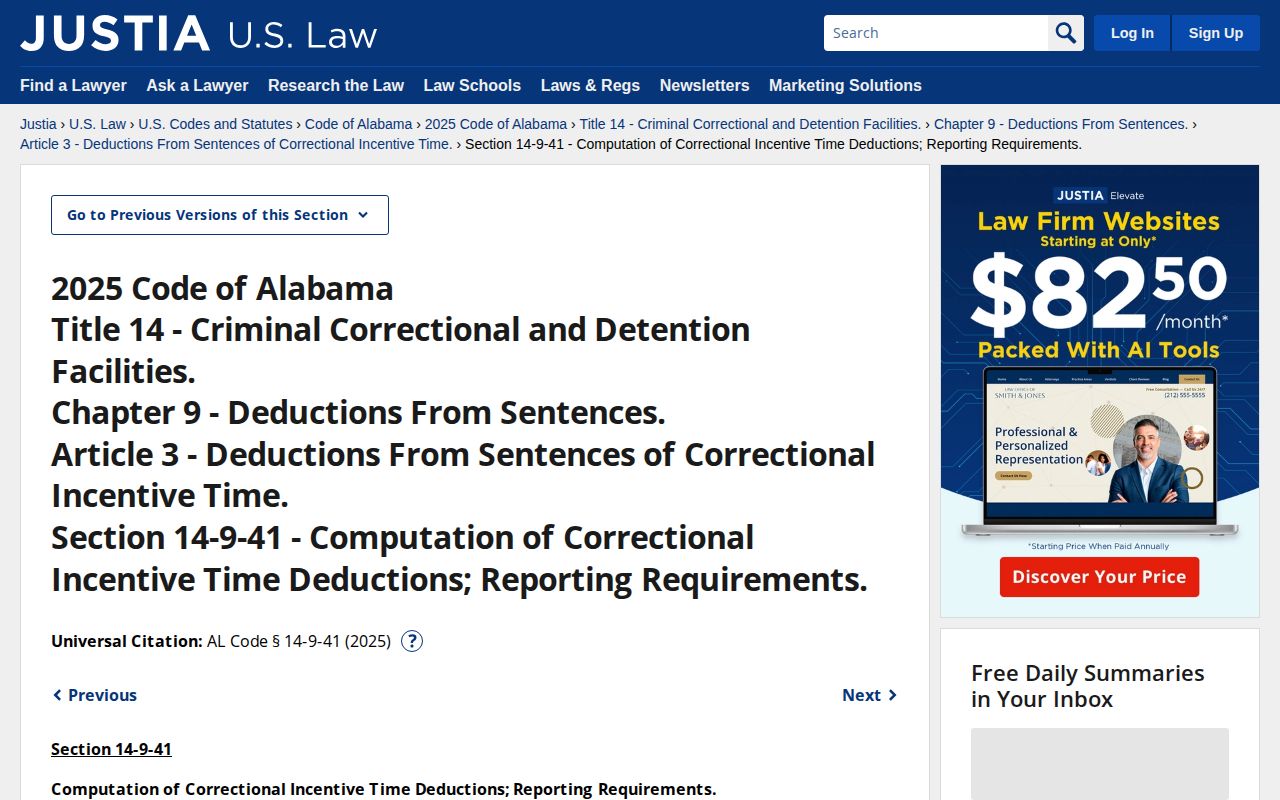
The statute is a release-date factor, but it is not a calculator. Eligibility, class, sentence type, and discipline control whether credit applies.
Covington County Good Time Rules
Alabama correctional incentive time is governed by Section 14-9-41. The statute gives current earning rates of 30 days for each 30 days served in Class I, 15 days for each 30 days served in Class II, 5 days for each 30 days served in Class III, and no credit in Class IV. Class IV is described as flat time or day-for-day. A person must progress through classifications and does not receive retroactive higher-class credit for earlier lower-class time.
Important exclusions apply. The statute bars correctional incentive time for a Class A felony, a crime causing death by deadly weapon, a life sentence, a death sentence, a sentence over 15 years, or a child sex offense as defined by Alabama law. Certain violent or child-abuse offenses also limit Class I placement. A page should not estimate a release date from sentence length alone because the exclusion rules, class status, jail credit, sentence structure, and discipline all matter.
| Classification | Credit Rate in Research |
|---|---|
| Class I | 30 days for each 30 days actually served |
| Class II | 15 days for each 30 days actually served |
| Class III | 5 days for each 30 days actually served |
| Class IV | No correctional incentive time |
Covington County Date Changes
A projected release date changes when one of the controlling records changes. Discipline can revoke accrued good time. New cases can alter the term. A clerk correction can change jail credit. Consecutive sentences add time in sequence, while concurrent sentences run together and use the longer controlling term. Detainers or holds can keep a person from community release even when one agency's sentence or booking ends.
| Change | Possible Effect |
|---|---|
| Corrected jail credit | May move the ADOC Minimum Release Date earlier or later. |
| Disciplinary loss | May revoke good time and delay release. |
| New sentence or amended case | May change total term, consecutive time, or concurrent structure. |
| Parole grant | Requires ABPP home-plan verification and ADOC coordination before physical release. |
| Federal or ICE hold | May turn a local release into a transfer to another agency. |
Covington County Parole Dates
Parole dates are often misunderstood. ADOC's Parole Consideration Date is a tentative date set by the parole board. ABPP says the set date means the file can be processed after eligibility, not that the person will have a hearing that month or leave custody. Eligibility depends on sentence, crime, jail credit, ability to earn good time, time served, and court orders. If parole is granted, ABPP still verifies the home plan and works with ADOC to schedule release.
Mandatory release is different from parole. ABPP says eligible offenses committed on or after January 30, 2016 may fall under Alabama Code Section 15-22-26.2, excluding life sentences and child sex offenses. The windows range from three to five months before end of sentence for shorter sentences to twelve to twenty-four months before end of sentence for sentences of ten years or more. It is release to supervision, not proof that all supervision has ended.
Covington County Sentencing Terms
Truth-in-sentencing in Alabama needs careful language. The Alabama Sentencing Commission statute page discusses voluntary truth-in-sentencing standards. Under Section 12-25-36, when a sentence is imposed under those standards, the sentence includes a minimum and extended term plus post-release supervision, and no incarcerated offender may be released before the minimum term expires.
The research did not support a blanket statement that all Alabama inmates serve a fixed percentage. For Covington County release-date content, rely on the judgment, ADOC fields, good-time eligibility, jail credit, parole, mandatory release, truth-in-sentencing language if used by the court, and any holds. A simple percentage answer can be wrong.
Covington County Jail Release Dates
County-jail release dates are not computed the same way as ADOC state-prison dates. For local jail cases, the release may depend on bond, recognizance, time served, court order, dismissal, probation, transfer, hold, or sentence completion. Alabama's good-time statute assigns administration to sheriffs for county jail prisoners when the statute applies, but that does not mean every person in jail earns credit or has a public calculator.
Because Covington County does not publish an online release-date calculator or public recent-release feed, the verification route is the jail plus court. Call the jail for custody and release status. Check the court docket for the sentence, case action, bond, and jail credit. If the person moved to ADOC, use the ADOC Minimum Release Date. If supervision follows, use ABPP. If another agency takes custody, use the correct federal or ICE path.
The court record is especially important for local sentences. The circuit clerk's record may show whether the sentence is complete, whether time served applied, whether probation was ordered, or whether a later revocation changed the custody path. The jail can confirm the release event, but the court record explains the order behind that event. For a state sentence, the same local court information can affect ADOC's jail-credit entry and therefore the Minimum Release Date.
When a Covington County sentence involves both local jail time and ADOC custody, keep the court judgment, jail credit, and ADOC minimum release field together. A change in one record can affect the date shown in another system.
Note: ADOC historical releases may disappear from the public inmate search, so a no-result is only a reason to verify through other records.
Public Record Search
Sponsored Results